
US-based boutique investment company GQG Partners has shot into limelight with its Rs 15,446-crore Adani wager.

The share of Life Insurance Corporation of India (LIC) in monthly new business premium (NBP) in the life insurance sector declined to 58.50 per cent in September 2023 from 68.25 per cent in September 2022 -- a drop of 975 basis points -- owing to shortcomings in the product and distribution side of business. However, the market share saw a marginal uptick from the 57.37 per cent recorded in August this year. According to the monthly business data released for September 2023 by the Life Insurance Council, the NBP of LIC up to September 2023 stood at Rs 92,462.62 crore as compared to about Rs 1.25 trillion in the same period a year ago.

rediffGURU Ramalingam Kalirajan answers your personal finance queries.

The information and technology (IT) sector, which has been going through a rough patch lately, was among the top draws for equity mutual funds (MFs) in July. MF schemes together invested a net of Rs 1,800 crores in IT stocks last month after pulling out around Rs 700 crore from the sector in June, according to a report by ICICI Securities.

Do you have financial planning queries? Ask rediffGURU Abhishek Dev.

Top ten banks of the world includes 4 from the USA, 4 from China and one each from the UK and Australia

K K Mistry, currently vice-chairman and managing director, will take over as vice-chairman and CEO when Parekh steps down on January 1, 2010.

rediffGURU Sunil Lala answers your MF-related queries.

This is a good opportunity for long-term investors to pick quality small and midcap stocks at reasonable valuations.

The growth was led by family-owned companies and business groups with presence in pharmaceuticals, information technology services, and consumer products.

Despite multiple headwinds at the start of 2023, the Indian markets delivered a strong performance, posting 19-20 per cent growth for the year. Even as new records were set, investor sentiment remains strong going into 2024, given the lower inflation, expectations of steady to lower interest rates, higher economic growth, and strong inflows. However, the overriding concern for most brokerages is valuations.

rediffGURU and financial planning expert Colonel Sanjeev Govila (retd) answers your personal finance-related questions.

Funds raised by India Inc. through offshore loan syndication hit a 15-year high in 2023 with companies and banks raising $21.4 billion, the highest since 2007. The momentum is expected to continue in 2024 as well with over $4 billion fund raising expected in the first three months of this year. Companies raise funds, both onshore and offshore, depending on interest rates and activities. Funds raised offshore can be deployed in overseas activities.

From the Sensex pack, Hindustan Unilever, Asian Paints, Bajaj Finance, Nestle, Bajaj Finserv, Reliance Industries, Larsen & Toubro, Maruti, Infosys and Bharti Airtel were the major laggards.

From the Sensex pack, ITC jumped 4.74 per cent. The other major gainers were IndusInd Bank, Hindustan Unilever, Infosys, Wipro, HCL Technologies, Tata Consultancy Services and ICICI Bank. HDFC, Tata Steel, Bajaj Finance, NTPC, Power Grid and HDFC Bank were the major laggards.

Union Bank of India has tied up with HDFC Standard Life Insurance Company Ltd to provide bank depositors an insurance cover under group policy with a target to bring in 50,000 customers under risk cover by March.

M&M was the biggest loser in the Sensex chart, falling 6.39 per cent, followed by Tech Mahindra, Nestle India, Bajaj Finance, Axis Bank, ITC, JSW Steel, HDFC Bank and RIL. On the other hand, Sun Pharma, Tata Motors, Bharti Airtel, L&T and Infosys were among the winners, rising up to 2.10 per cent.
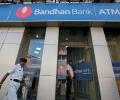
It is 10 years since Bandhan Financial Services became the first microfinance institution (MFI) to receive the universal bank licence. A year later, in 2015, it started operations. Bandhan's entry into banking was seen as a vote of confidence by the Reserve Bank of India (RBI) for the country's microfinance sector. Subsequently, the RBI awarded small finance bank licences to nine MFIs.

The benchmark National Stock Exchange Nifty has rallied 4 per cent, or 750 points, from this month's low to end at 19,732 on week ending November 17. Technical analysts say the market could consolidate around the current levels as it is nearing the resistance zone. "The near-term uptrend status of the market remains intact, but there is a possibility of some more consolidation or minor weakness for the Nifty in the next one to two sessions.
Reliance Industries Ltd was the biggest wealth creator during the five-year period from 2018 to 2023 while Adani Enterprises Ltd was the top all-round wealth creator, according to a study by Motilal Oswal Financial Services. The study, based on stock market performance of companies, said for the fifth time in succession, Reliance emerged as the largest wealth creator, adding Rs 9,63,800 crore wealth over 2018-23. It was followed by Tata Consultancy Services (Rs 6,77,400 crore wealth addition), ICICI Bank (Rs 4,15,500 crore), Infosys (Rs 3,61,800 crore) and Bharti Airtel (Rs 2,80,800 crore).

The improving outlook for the power sector has caught the interest of dividend yield funds. In the first four months of the current financial year (2023-24, or FY24), five of the six largest dividend yield funds have shown a notable increase in their exposure to stocks within the power sector. Some have even introduced new stocks to their portfolios.

HDFC MF witnessed 17% rise in investment in its schemes to Rs 6,462 crore by group companies during May.

Do you have financial planning queries? Ask rediffGURU Anil Rego.

rediffGURU Dev Ashish answers your personal finance and mutual fund queries.

The recent equity market weakness has sobered up investor mood, but the coming festive season is keeping analysts upbeat on stocks related to the consumption basket. Among the lot, fast-moving consumer goods (FMCG), retail, and consumer electronics segments are expected to do well over the next few months, and investors should thus selectively take bets in these pockets, analysts suggest. "We expect good volume growth for the FMCG sector during the festive season with some improvement in rural demand.

"We will raise Rs 300 crore via bonds of two-, three- and five-year tenures. This will be our maiden bond issuance and is part of our effort to widen funding sources," says Vimal Bhandari, executive vice-chairman and chief executive officer (CEO), Arka Fincap. The firm, a subsidiary of Kirloskar Oil, is only five years old and small (assets of around Rs 5,000 crore with an "AA" rating), but the response to this float will be closely watched: It would be the first by a non-banking finance company (NBFC) after Mint Road upped the risk weights on bank exposures to them by 25 percentage points. The move by the Reserve Bank of India (RBI) has caught NBFCs off guard even though the issue had been flagged by Governor Shaktikanta Das with their corner-room occupants (and that of banks) in July and August 2023 - on consumer credit and the dependency on bank borrowings.

The Sensex jumped nearly 900 points and the Nifty rallied over 272 points on Friday, bouncing back from the previous day's fall, following a positive trend in global equities and fresh foreign fund inflows. The BSE Sensex rallied 899.62 points or 1.53 per cent to end at 59,808.97 after starting the trade on a positive note. During the day, it jumped 1,057.69 points or 1.79 per cent to 59,967.04.
State-owned Life Insurance Corporation of India (LIC), which completes one year of its listing on Tuesday, presents a sorry scorecard as far as its stock market performance goes. Shares of the insurance behemoth are down 40 per cent over their issue price of Rs 949 to Rs 567 apiece. The Sensex, on the other hand, has risen 14 per cent in the past one year.

rediffGURU Ramalingam Kalirajan answers your personal finance queries.

It is, thus, logical that some compensation is paid to a lender, especially when a customer is poached within two years, Parekh noted.

Do you have financial planning queries? Ask rediffGURU Anil Rego.

These stocks offer the best combination of maximum 'buy' recommendations from brokerages and share price upside over the next 12 months.

The banking regulator was uncomfortable with the runaway pace at which consumer credit was growing.

Among the Sensex firms, Tech Mahindra, Wipro, Infosys, Tata Consultancy Services, HCL Technologies, Larsen & Toubro, ITC, Sun Pharma, NTPC and Titan were the major gainers. Nestle, Axis Bank, Tata Motors, ICICI Bank, HDFC Bank and Bharti Airtel were the laggards.

Actively-managed large-cap mutual fund (MF) schemes have managed to regain some lost sheen this year after faring poorly in the 2022 calendar year (CY22). At the end of the first six months (H1) of CY23, 78 per cent of the active large-cap schemes were ahead of the Nifty50 index funds as against just 26 per cent in 2022. When compared to the Sensex index funds, 61 per cent active funds have delivered better returns, shows an analysis of Value Research data.

>It's not easy to predict the market. But there are at least two positive factors to back the PSU banks, explains Tamal Bandyopadhyay.

As the world celebrated International Day of Persons with Disabilities (PwD) on December 3, corporate India has kept up with efforts to make workplaces more inclusive and accessible. Organisations across sectors are taking initiatives such as equipping offices with practical work tools like Braille-friendly and voice-enabled lifts and screen readers. While inclusion has gained pace, only 11.3 per cent (or 3.4 million out of 30 million) Indians with disabilities have jobs.

The Mumbai-based real estate developer Oberoi Realty has been one of the top-performing companies in its segment and most brokerage remains bullish on the stock. The company's stock price is 52 per cent in the last 12 months beating the broader market by a huge margin. The benchmark BSE Sensex is up just 6.5 per cent during the period.
Amid cooling raw material prices, the crude-oil linked companies, which includes paint and tyre firms, have been on a roll over the past one year. Shares of related companies have gained up to 84 per cent, as against a 14 per cent rise in the S&P BSE Sensex. Analysts, however, believe stretched valuations in both these sectors could trigger a de-rating.

People are availing far more of certain kinds of unsecured loans than was the case before the pandemic. Bank lending for buying consumer durables and funding of credit cards and other personal loans have risen by Rs 6.9 trillion between August 2019 and August 2023, shows a Business Standard analysis of data from the Reserve Bank of India (RBI). These loans are typically unsecured, which means they are provided without collateral.
 © 2026 Rediff.com - Advertise with us - Disclaimer - Privacy Policy - Sitemap - Feedback - About us - Terms of use - Grievances